#e4mXplains: Google is putting Search on the front page as AI starts selling ads of its own
The creative for the print ads is built around advertiser case studies, with Google highlighting measurable sales and purchase growth. e4m decodes the timing
 by
by
Published: Sep 14, 2026 8:59 AM | 6 min read
 Follow Us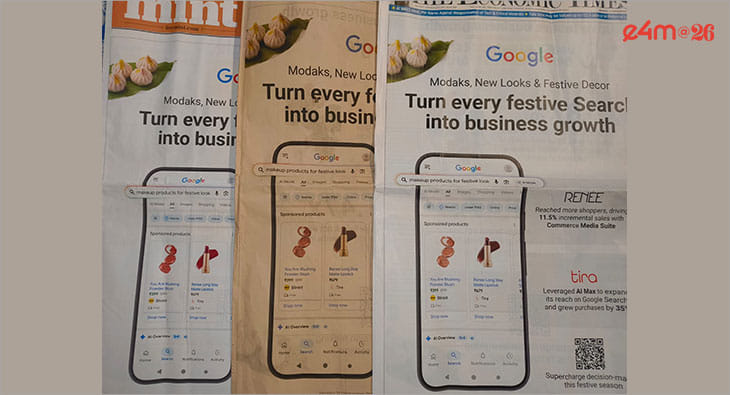

- Google has launched a significant advertising campaign in India, promoting its Search services to advertisers during the festive season, emphasizing the potential for business growth through measurable sales increases.
- The campaign highlights successful case studies from brands like RENÉE and Tira, showcasing how Google's AI tools, such as Commerce Media Suite and AI Max, can enhance advertising effectiveness.
- As India approaches a record festive shopping season, online sales are projected to rise significantly, with 51% of online shoppers recently using AI chatbots for purchase research, indicating a shift in consumer behavior.
- Google faces competition from OpenAI's ChatGPT Ads, which has quickly gained traction in the advertising market, but Google aims to reinforce its dominance by showcasing the effectiveness of its established Search platform enhanced by AI.
For years, Google Search barely needed an advertisement for itself. It was the place where advertising happened. It’s so ubiquitous so as to be a verb.
That makes the sight of Google buying prominent front-page space across India’s financial press this festive season rather interesting. Never mind their massive advertising blitz during the IPL.
Across publications today, (on Ganesh Chaturthi no less, I wonder which obstacles need overcoming), including The Economic Times, Mint and Financial Express, Google has been running essentially the same pitch to advertisers: “Turn every festive Search into business growth.”
The creative is built around advertiser case studies, including cosmetics brand RENÉE and beauty retailer Tira, with Google highlighting measurable sales and purchase growth through products such as Commerce Media Suite and AI Max.
Google wants AI to become marketers’ strategist. Read more
The timing is difficult to ignore.
India is heading into what is expected to be another record festive shopping season. Datum Intelligence forecasts online festive sales of ₹1.50 lakh crore to ₹1.55 lakh crore in 2026, up 25–29% from ₹1.20 lakh crore last year. The firm estimates that the season will add roughly ₹30,000 crore in sales, driven almost entirely by more shoppers and more orders rather than bigger baskets.
Can ChatGPT sell context? Read more here
There is an AI wrinkle in that data too. Datum’s June survey of 6,218 online shoppers found that 51% had used an AI chatbot to research an online purchase in the previous three months, slightly ahead of comparison websites, price trackers and online forums.
Meanwhile, India’s overall advertising market is expected to reach ₹2,01,891 crore in 2026, according to WPP Media, growing 9.7% over the previous year. The agency group has pointed to the convergence of AI, commerce and privacy as some of the forces reshaping how advertisers reach consumers.
In other words, there is plenty to fight over.
And Google has considerably more at stake than most.
Alphabet’s latest quarterly results underline just how enormous the existing Search machine remains. The company generated $119.8 billion in revenue in the second quarter of 2026, with Google advertising accounting for $81.6 billion. Search and other advertising alone brought in $63.3 billion during the quarter, up 17% year-on-year.
That helps explain the simplicity of Google’s festive-season argument. It is not asking advertisers to believe in an entirely new behaviour. It is reminding them that Search already sits very close to commercial intent, then supplying case studies to prove that the machinery still works.
The wrinkle this year is that Search is no longer the only place where that intent is being expressed.
OpenAI began rolling out ChatGPT Ads in India in late August, placing sponsored messages below answers for logged-in adult users on the Free and Go tiers. More than 50 brands were slated to participate at launch, with WPP and Omnicom serving as its first agency partners in the country. Self-serve access followed through Ads Manager, opening the platform to Indian businesses beyond those initial agency relationships.
Globally, the experiment has moved quickly. OpenAI said on August 31 that ChatGPT Ads had reached a $1 billion annualised revenue run rate less than 200 days after launch and was being used by tens of thousands of advertisers. The company says ChatGPT itself now has more than one billion weekly active users.
That remains tiny beside Google’s advertising empire. Google Search alone produces ChatGPT Ads’ current annualised revenue in about a day and a half. Youtube takes a little more than a week.
But advertising markets rarely become interesting only after the challenger reaches parity.
The more important question is whether consumer intent begins forming somewhere else.
Traditional search advertising was built around an elegantly simple proposition: a person types what they want, and an advertiser pays to appear at precisely that moment. Conversational AI complicates that model because the query can become an extended discussion. A user can ask for recommendations, narrow a shortlist, compare products, ask follow-up questions and potentially reach a decision without following the traditional sequence of search results and links.
OpenAI is now trying to monetise that behaviour directly.
Google, for the moment, is taking a somewhat different route, and notably, cannot yet offer advertisers the equivalent inside Gemini.
Instead, its commercial AI story remains centred on using AI to improve the advertising products it already owns. At Google Marketing Live earlier this year, the company positioned Gemini as an engine powering advertising and marketing capabilities across Search and YouTube rather than as an advertising destination in its own right.
That distinction makes the current newspaper campaign more revealing than another seasonal media push.
Google is not primarily advertising Gemini to marketers on those front pages. It is advertising Search enhanced by AI, backed by measurable performance.
In the Tira case study used in the campaign, Google says AI Max helped the beauty retailer increase purchases by 35% while reducing customer-acquisition costs. The RENÉE example similarly presents Google’s Commerce Media Suite as a mechanism for producing incremental marketplace sales.
The message is difficult to miss: whatever happens to the way consumers discover information, Google wants advertisers to believe that Search remains the place where intent turns into revenue.
And that matters especially during the festive quarter, when retailers, ecommerce platforms and consumer brands are concentrating some of their largest performance-marketing budgets of the year.
There is also a useful asymmetry emerging between the two companies. OpenAI is trying to build a new advertising surface inside an AI assistant. Google is using AI to reinforce one of the most lucrative advertising surfaces ever created.
Neither strategy necessarily excludes the other. Google could eventually introduce advertising more directly into Gemini, while OpenAI is already expanding the plumbing around ChatGPT Ads and the ways advertisers can buy into it.
But for now, their commercial stories remain noticeably different.
Which may explain why Google’s current message to India’s business audience is unusually concrete, and why this festive season, Google has taken out the front page to show the receipts. Not that Search is exciting. Not even that Search is powered by AI.
It may simply be “hey, Search still sells things.”
Tomorrow, exchange4media will take a deeper look at the emerging advertising formats inside AI assistants, and how ChatGPT, Google Search and AI Mode, Copilot and other platforms are approaching what could become the next major digital advertising surface.
Read more news about Digital Media, Internet Advertising, Marketing News, Television Media, Radio Media
For more updates, be socially connected with us onInstagram, LinkedIn, Twitter, Facebook, YouTube & Google News